
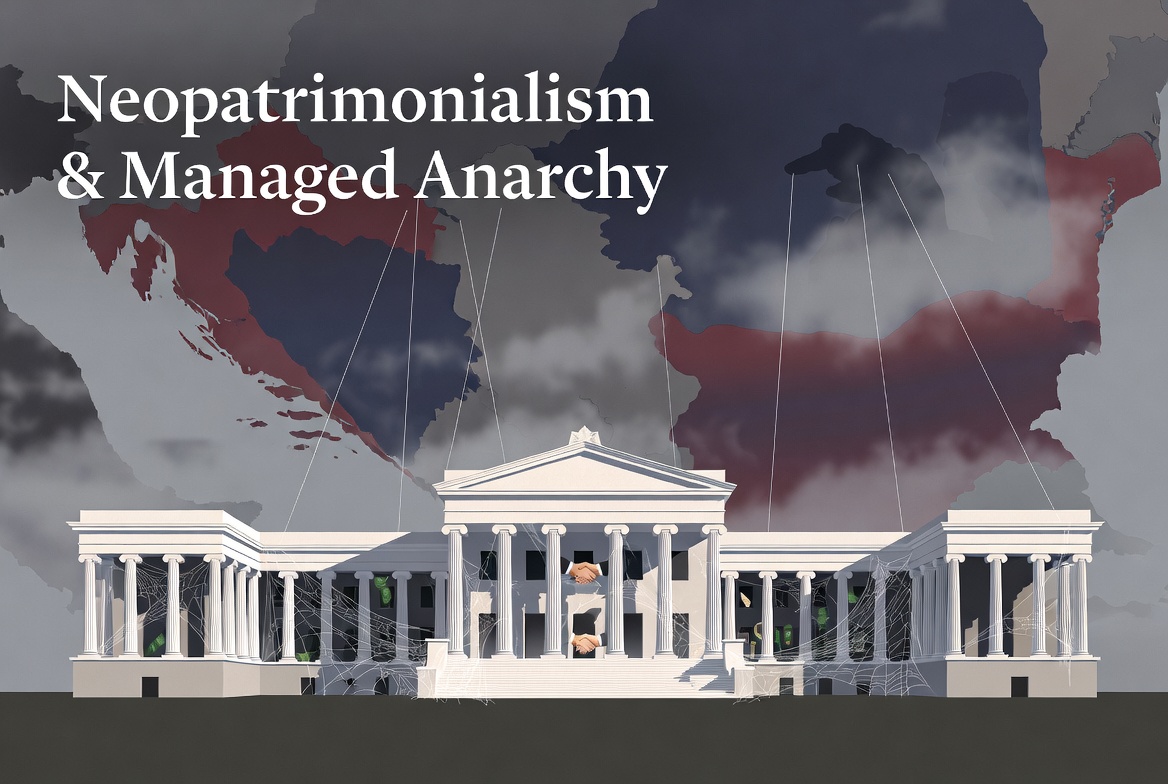
In Albania and most of the Western Balkans, neopatrimonialism has transformed from a relic of the post-communist transition into a functional model of power that has evolved and consolidated itself in recent years. It coexists with an institutional facade of elections, judicial reforms, negotiations with the EU, while real power derives from personal networks, clientelism and informal control over public resources. This model has produced a kind of “functional anarchy” or “managed chaos”, which has nothing to do with philosophical anarchism (voluntary decentralization, horizontal autonomy), but with the deliberate weakening of autonomous institutions in order to maintain personal dependence on the leader or the elite.
How is it working in practice today?
In Albania, after more than a decade in power (and now the fourth mandate of Edi Rama after the 2025 elections), the formal state exists. In Albania there is SPAK, there is reform in the judiciary, there is also economic growth from tourism and construction. But real power continues to operate through patronage. Appointments in the administration, public tenders, the distribution of jobs and subsidies are often linked to personal or party loyalty. Recent scandals involving senior ministers show that when investigations touch on the internal network, the reaction is political protection, not institutional accountability. The law is being applied selectively, appearing harsh on opponents of the government or the “unnecessary” and softer on relatives and patronage connections.
This situation has created a classic neopatrimonial paradox.
The state appears politically strong (charismatic leader, clear parliamentary majority, control over the media and the informal economy), but institutionally weak. Institutions have become “empty”, because in significant parts they exist in the digital system, but they function as extensions of clientelistic networks.
People still see that to solve a problem (job, permit, justice) they should not go to an institution (even a digital one), but to the “right person”, a deputy, a regional political leader, or a mayor or a party patron. This personal dependence strengthens the power of the leader, because he becomes the supreme arbiter in a system without clear rules.
In neighboring countries and beyond (Montenegro, Kosovo, North Macedonia, Serbia and Bosnia) the model is similar, but of course it also contains local variations.
In these countries too there are patronage networks, there are state capture, there are also ethnic or political polarizations, which keep societies fragmented. The “anarchy” we see is not the lack of power, but the lack of impersonal order. There is order, but it is informal, based on loyalty, fear or immediate interest.
The neopatrimonial model is not only producing institutional deformation, but is gradually changing the collective psychology of society.
When citizens perceive the state not as a neutral arbiter, but as the political property of a party, a group or a leader, then the erosion of public trust begins and takes effect. This is already happening with institutions that are losing moral and functional legitimacy, while meritocracy is replaced by political conviction, personal connections and clientelism.
In this climate, young people in particular no longer see a fair perspective of competition. The massive emigration from Albania in recent years is not only an economic phenomenon, but also a vote of no confidence in the system. A part of society survives by entering clientelistic networks, while the rest physically leaves or retreats into political and social apathy.
On the economic level, the consequences are equally profound.
The economy seems to be functioning not on the basis of free competition and productivity, but on access and proximity to power. Clientelism and structural corruption are favoring politically connected oligarchs, privileged companies and manipulated tenders. Economic growth may be real in macroeconomic indicators, as it operates on indicators from construction, tourism or consumption, but the main problem is that it has remained concentrated in the metropolis and is uneven in redistribution.
Independent businesses are facing distorted competition, while the informal economy continues to be a survival mechanism. Gradually, public assets (land, contracts, funds and strategic assets) are being privatized informally by power networks, creating a clientelistic capitalism rather than a free market economy.
This structure has also weakened democracy itself.
The opposition is fragmented and consumed by internal conflicts or delegitimized by its own problems of corruption and lack of alternative. The result is a self-reinforcing cycle with a dominant power that continues to concentrate control, while the opposition is limited to accusatory rhetoric without generating public trust.
Political polarization is being kept constantly high, not necessarily because of ideological differences, but because permanent tension serves to mobilize voters and maintain control. In this atmosphere, institutional dialogue and even the most profound reforms on paper become almost impossible in practice.
The greatest danger is that the political and economic system has entered a state of “managed chaos,” where stability is maintained only as long as social and economic tensions are controlled.
But this balance is fragile. An economic crisis, an even greater corruption scandal, mass protests, or international pressure could destabilize the entire structure.
In the Balkans, this institutional weakness is creating favorable terrain for external authoritarian influences. Former and new great powers are often preferring relationships with strong personal leaders and centralized systems because they are more predictable and easier to influence than democracies with strong and transparent institutions.
In the coming decade, the political model of many Balkan countries, including Albania, is likely to consolidate not as functional liberal democracies, but as a hybrid regime where formal institutions coexist with informal power networks. European integration will continue to serve as a legitimizing narrative and a source of reform pressure, but reforms will often remain more procedural than transformative.
It is true that new anti-corruption strategies, transparency laws, and administrative reforms will be adopted.
But it is also true that implementation will remain selective, filtered by the interests of political and economic elites. Institutions like SPAK will constantly find themselves in a paradoxical tension, where on the one hand they will be held up as a symbol of reform and international legitimacy, but on the other hand they will be treated as a potential threat to the very power networks that have supported their existence. As long as they strike at opponents of power or peripheral figures, they will be promoted, but when they touch the real centers of influence they will face attempts at neutralization, delegitimization, or indirect control.
Meanwhile, emigration will continue to act as a social and economic hemorrhage.
The continuous departure of young people, professionals, and the active workforce is not only producing a demographic crisis, but is changing the very structure of society. A country that loses its most dynamic and meritocratic stratum gradually becomes more dependent on remittances, public administration, and clientelistic networks. This creates a dangerous paradox, because the more skilled people leave, the less capacity remains to change the system. In this way, emigration is not only a consequence of neopatrimonialism, but also becomes a mechanism that reproduces it.
The economy will continue to take the form of a dual structure.
On the surface, positive indicators will appear with growth in tourism, foreign investment, urban development, and modern service sectors. But in parallel, an informal and clientelistic economy will survive, where the connection to power remains more important than real competition. Serious and long-term investors will continue to hesitate in the absence of strong legal guarantees, predictable justice and protection from political arbitrariness. Instead of competitive capitalism, there is a real risk of consolidating a capitalism of privilege, where the winners are determined more by proximity to power than by economic efficiency.
On the social level, fragmentation will deepen further.
Political polarization will not be a simple clash between parties, but a way of organizing public life.
Horizontal trust between citizens, as the basic element for building functional communities and social solidarity, will remain low. In an environment where everyone perceives the other as part of a political camp, economic clan or clientelistic network, it becomes extremely difficult to give rise to authentic civic movements or a civil society with real impact. Society is atomized and individuals are locked into private interests, while the public space is filled with cynicism and distrust.
At the same time, the relationship with the European Union will become increasingly contradictory.
On the one hand, Brussels will demand the strengthening of institutions, the independence of the judiciary and a crackdown on corruption at the highest levels. On the other hand, the neo-patrimonial elites will adapt to this pressure without changing the essence of the system.
The dominant narrative will be: “we are pro-Europe, but against interventions that destabilize the country”.
Thus, the reform will be accepted as rhetoric and symbolism, but will be resisted whenever it affects the real mechanisms of political and economic control.
In the end, Albanian/Balkan neopatrimonialism is not producing anarchy in the classical sense of the absence of power.
On the contrary, it creates an order where power is highly personal, selective and non-transparent. It is like a “managed anarchy”, where institutions exist formally, but function according to the logic of personal relationships, political favors and loyalty to the leader.
This model has produced short-term stability for elites and a facade of functionality for international partners, but in essence it is consuming public trust and has inhibited long-term development and damaged civic dignity.
The way out of this cycle cannot come only through technical reforms or legal changes, but from a new spirit outside the neopatrimonialist circle.
But where will these people be found?
Perhaps precisely among those who today feel excluded from the system, which are mainly young people who reject clientelism, professionals who seek meritocracy, the diaspora who have seen functional institutions, entrepreneurs who are tired of political favoritism, and citizens who still believe that the state should serve the people, not the government.Great political transformations do not arise when the system is strong, but when society gets tired of living within it.