
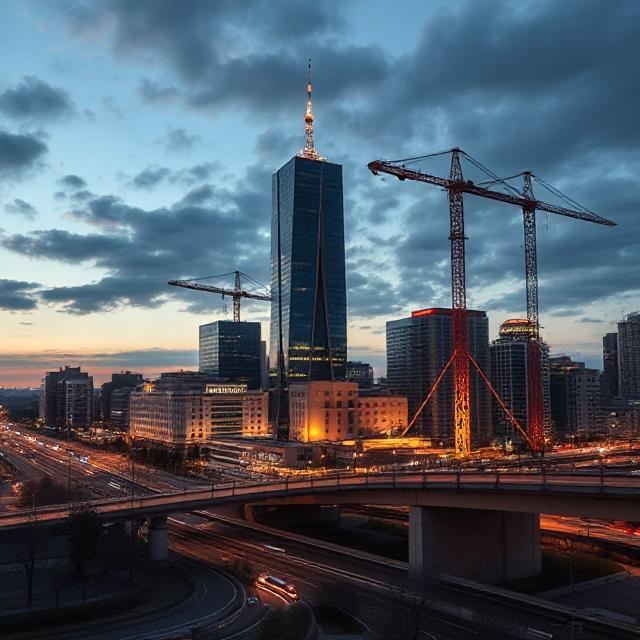
In Albania, the official discourse has been consistently built on a self-reinforcing logic.Every new public project, every urban development, every international event is presented as the exclusive product of “the government’s work.”
At the core of this approach lies the concept of governance as political property, where power is not a contract with society, but an instrument for distributing success within its own circle.
This model is not new, but it has reached a new level of sophistication in the era of information control and image production. The government not only constructs the narrative of achievements but also controls the mechanism for their dissemination and verification through dependent media, selectively presented statistics, and events with a strong visual protocol.
While in Tirana and in other areas of selective interest, architectural works are built and strategic investments are announced, the daily reality of the majority of Albanians remains disconnected from this development. Territorial and social disparities have grown deeper, not smaller, over the years.
Peripheral areas of the country, which lack both the electoral weight and the political connections to influence the public agenda, gain little access to infrastructure investments or basic services. Communities not politically loyal often remain excluded from funding, projects, and decision-making, even though political rhetoric claims the opposite. The distribution of public funds, both to municipalities and to social support projects, follows primarily an electoral logic, not one based on need or impact.
Citizen participation in decision-making is largely fictitious. Public consultations are formalities, responses are one-sided, and the voice of social, academic, or community opposition is minimized or ignored.
The Albanian diaspora: valued as a source of remittances, unwanted as a decision-making factor.
With over 1.4 million Albanians living abroad, remittances remain one of the main sources of economic stability for consumption, construction, investments, and social security. Yet, this part of the Albanian nation, which contributes directly and financially, is excluded politically and institutionally.
The lack of institutional representation channels for the diaspora is one of the most pronounced weaknesses of the current system. Policies for engaging the diaspora in development, in public funds, or in cooperation projects are mostly rhetorical. This sends a clear message to emigrants: “You are welcome as a source of foreign currency, but not as partners in building the country.”
The autocracy of image, or when the leader is more than the institution.
In the current system, the political leader stands above institutions, not within them. Political communication unfolds as a vertical monologue, where the leader’s word has absolute power—not only to set the political agenda but also to judge success, failure, and even patriotism.
This governance model has created a system where institutions no longer act independently, but conform blindly to directives without questioning their real impact. Careers and public resources are tied to loyalty rather than merit, building a clientelist network that rewards obedience over professionalism.Citizens, experts, and social voices are pushed to the margins, leaving decision-making as a closed circle of power. What is presented as “development” is too often measured in kilometers of roads or the height of glass towers in the capital, a carefully staged image of progress, while real, inclusive growth remains absent for the majority.
This model of governance fails to tackle the real problems that hold Albania back. Small businesses continue to struggle with low productivity, young people and workers remain trapped in structural informality, and social inequalities only grow deeper with time. A system built on exclusion, the concentration of power, and politically biased allocation of resources cannot be called democratic development. It is not fueled by justice or inclusion, but by the careful management of perception.
What Albania needs instead is a different kind of governance, one that does not present achievements as gifts from above, but as shared results of society. Real progress can only come from transparency in how public funds are spent, from the genuine inclusion of local communities and the diaspora in shaping decisions, from accountability for the impact of policies, and from institutions that function with professionalism rather than political loyalty. Only then can governance move from a stage-managed performance to a true partnership with its citizens.
A governance model that sees the citizen as a partner, not a spectator, can build a sustainable model of development, not façades, but real progress.
Three questions for social and political reflection:
– Can development be called inclusive when the diaspora, the peripheries, and politically non-loyal citizens are excluded from it?
– How can we build a decision-making architecture that gives voice to the whole society, not just the leader?
– Is it possible to move from a performance-based governance model to one based on representation?
Today, more than ever, Albania needs a new social contract—not just an agreement between citizen and power, but a collective commitment to rethink how we govern, how we share public goods, and how we build the future.
Paved roads and illuminated urban façades are not enough if they do not reflect real improvement in the lives of the majority. Sustainable development is not measured only in numbers, but in the sense of inclusion and belonging citizens feel toward their country.
If exclusion, bias, and political servility remain the main criteria for benefit and participation, then every “official achievement” will remain a partial reality, and every praise will be a monologue of political solitude.
Democracy is not built with spectators, but with active participants. Albania does not need more image—it needs more justice, inclusion, and genuine co-governance.